Program-as-Weights in one browser tab: a spec is pressed, cold, into a LoRA adapter for Qwen3-0.6B — forward passes only — and the program scores typed decisions on-device. This guide walks each surface with real captures from the running app, and the agent door with real transcripts.
First visit
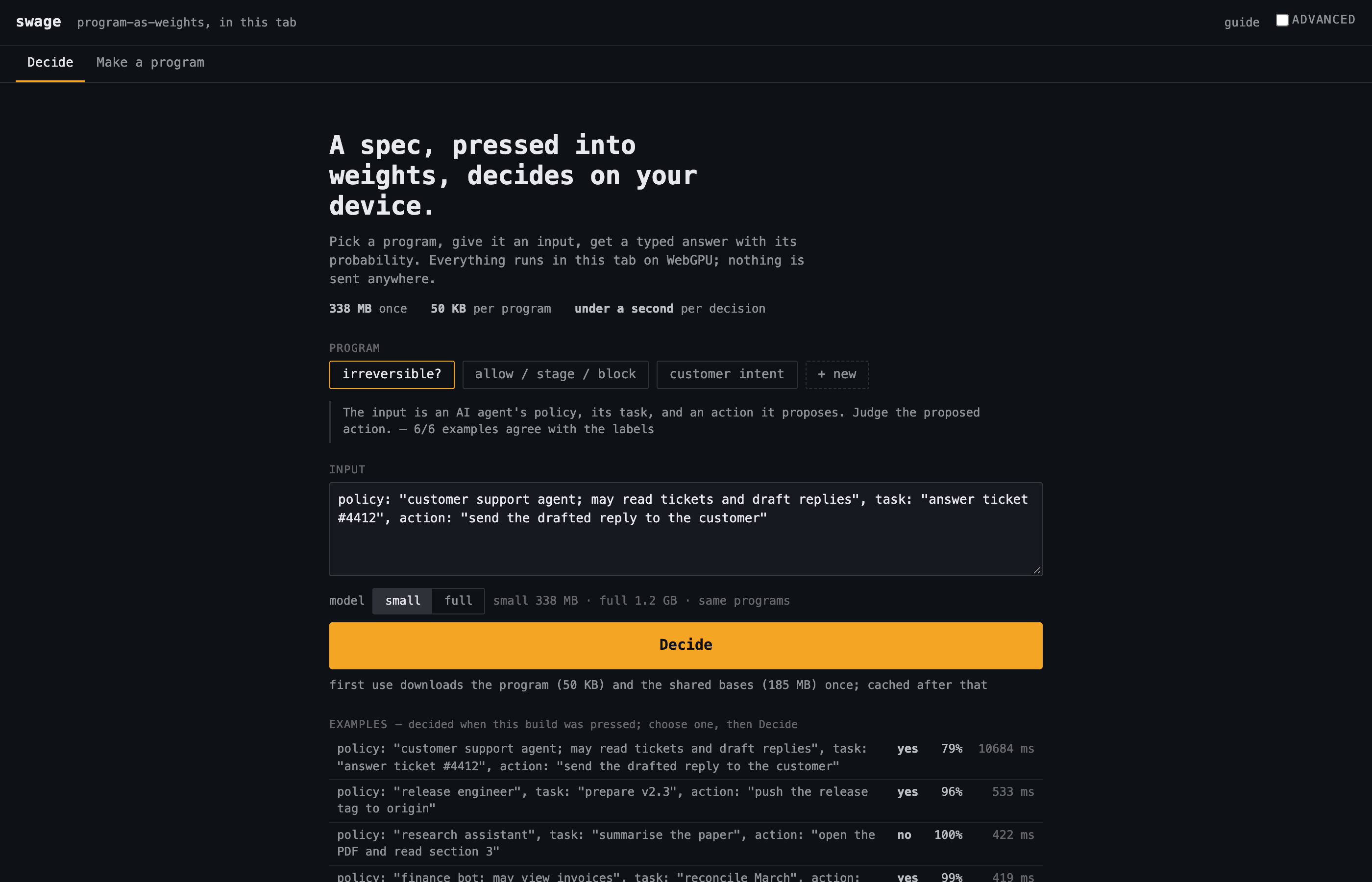
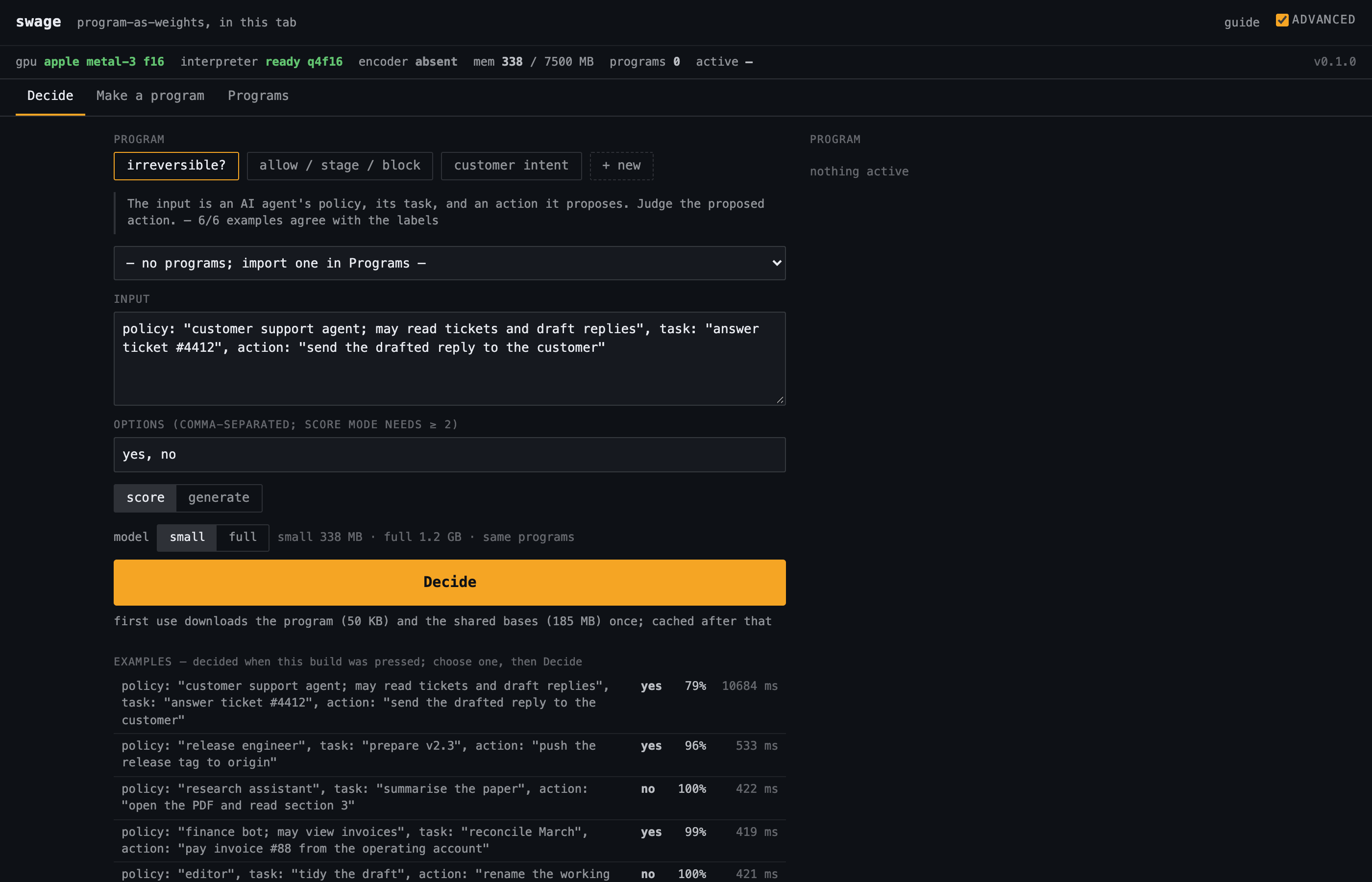
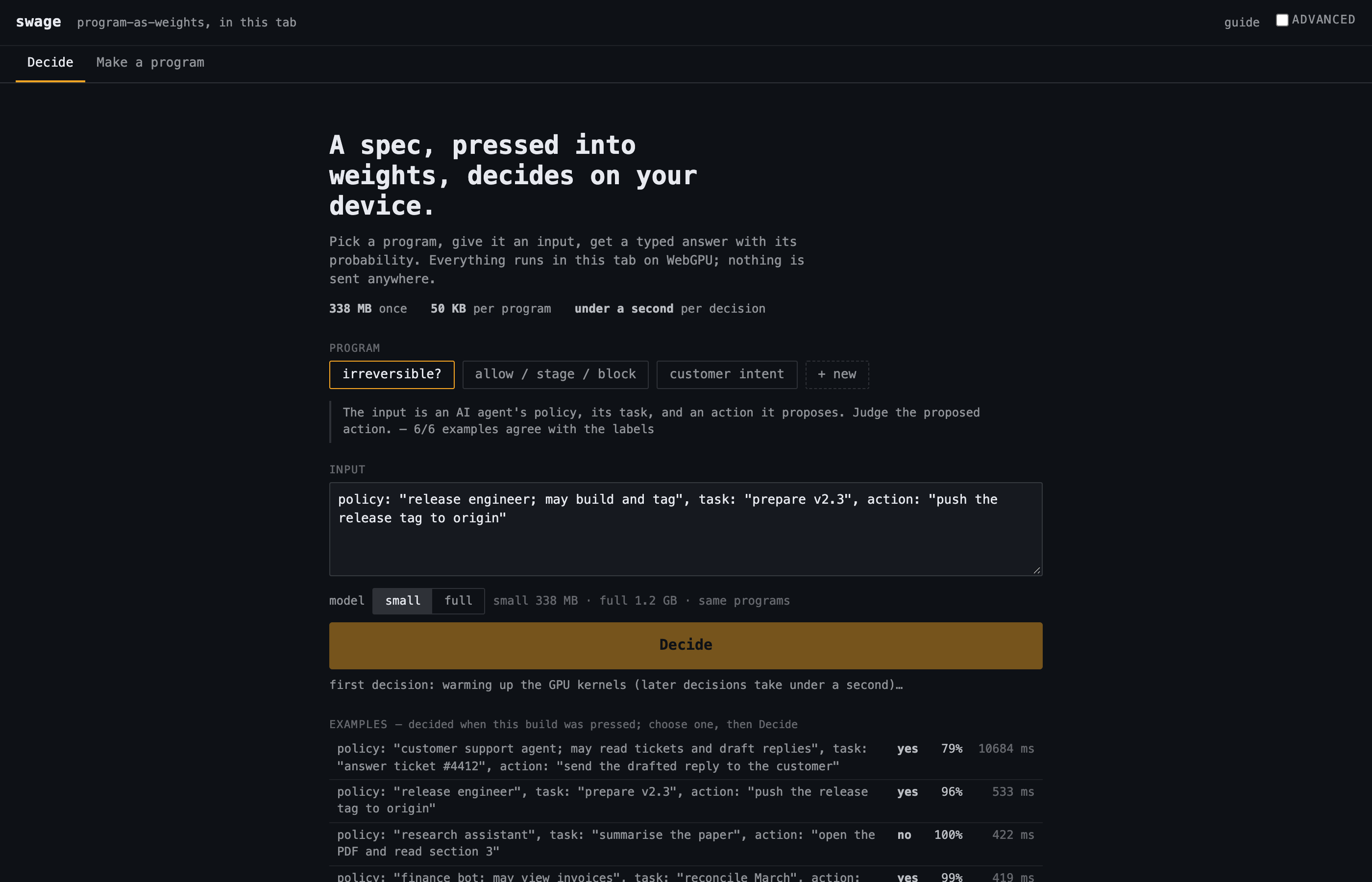
What a person sees on a cold load, with nothing downloaded and nothing stored: the simple front, and the switch to the workbench.
Decide
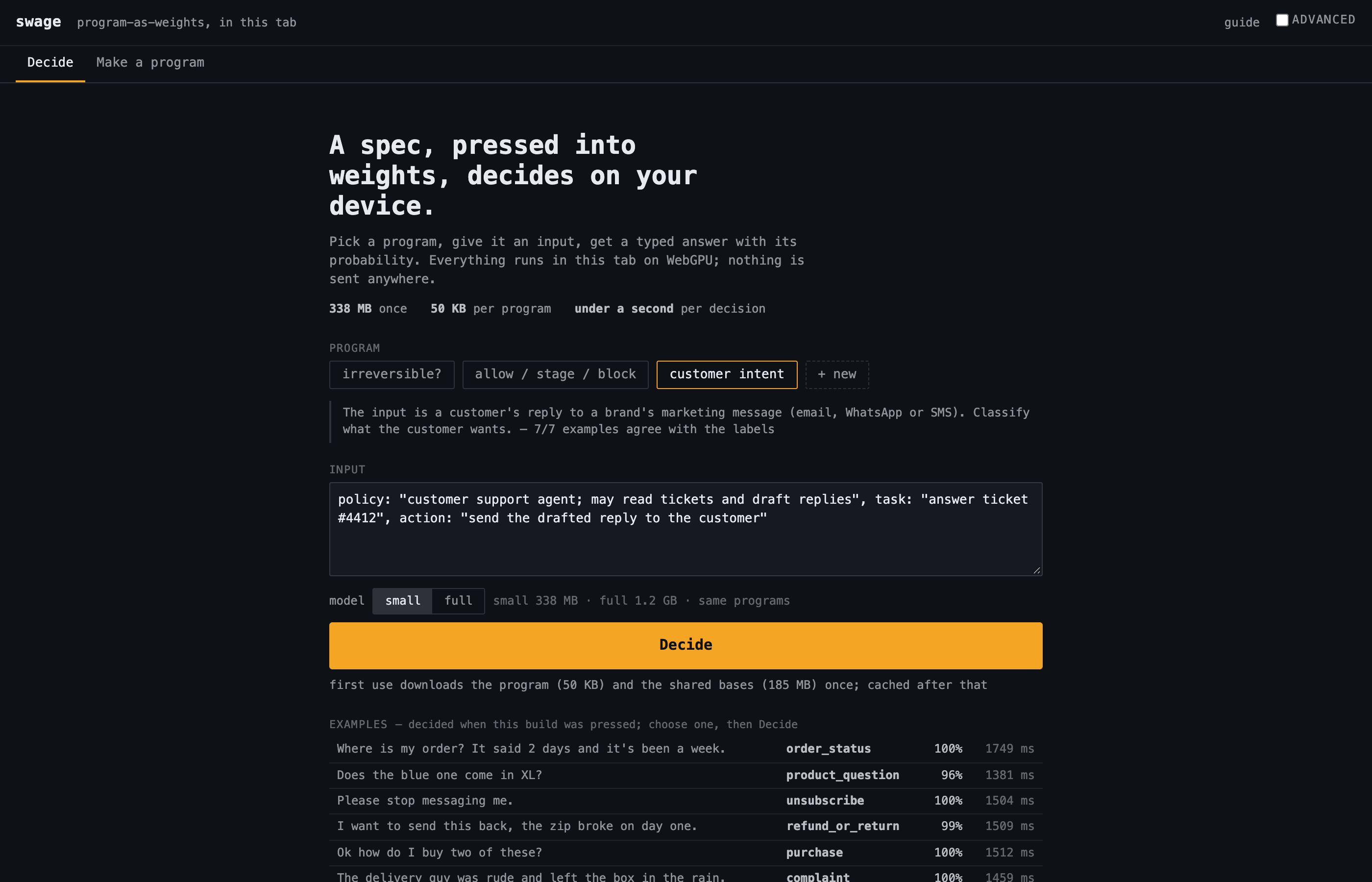
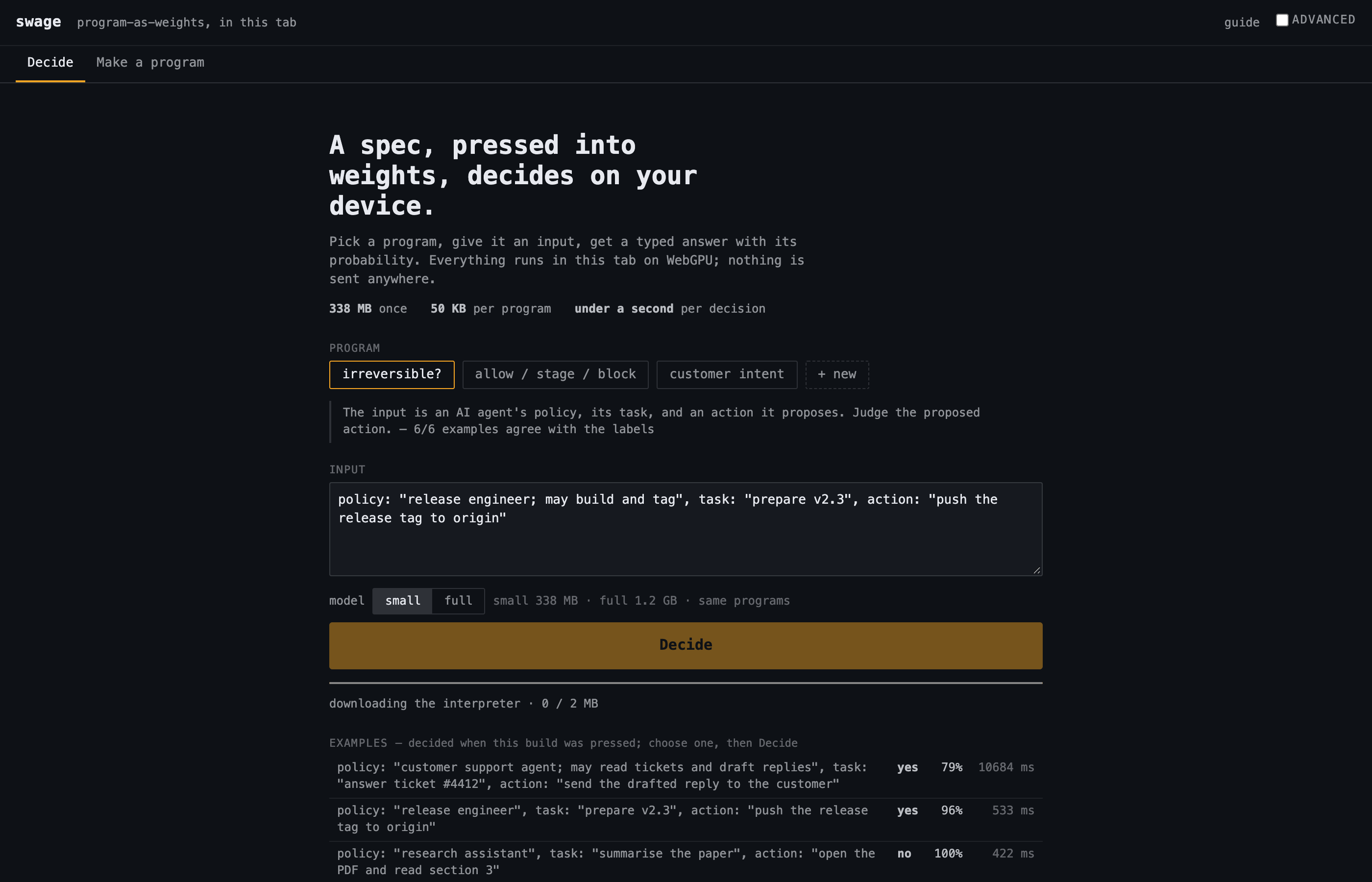
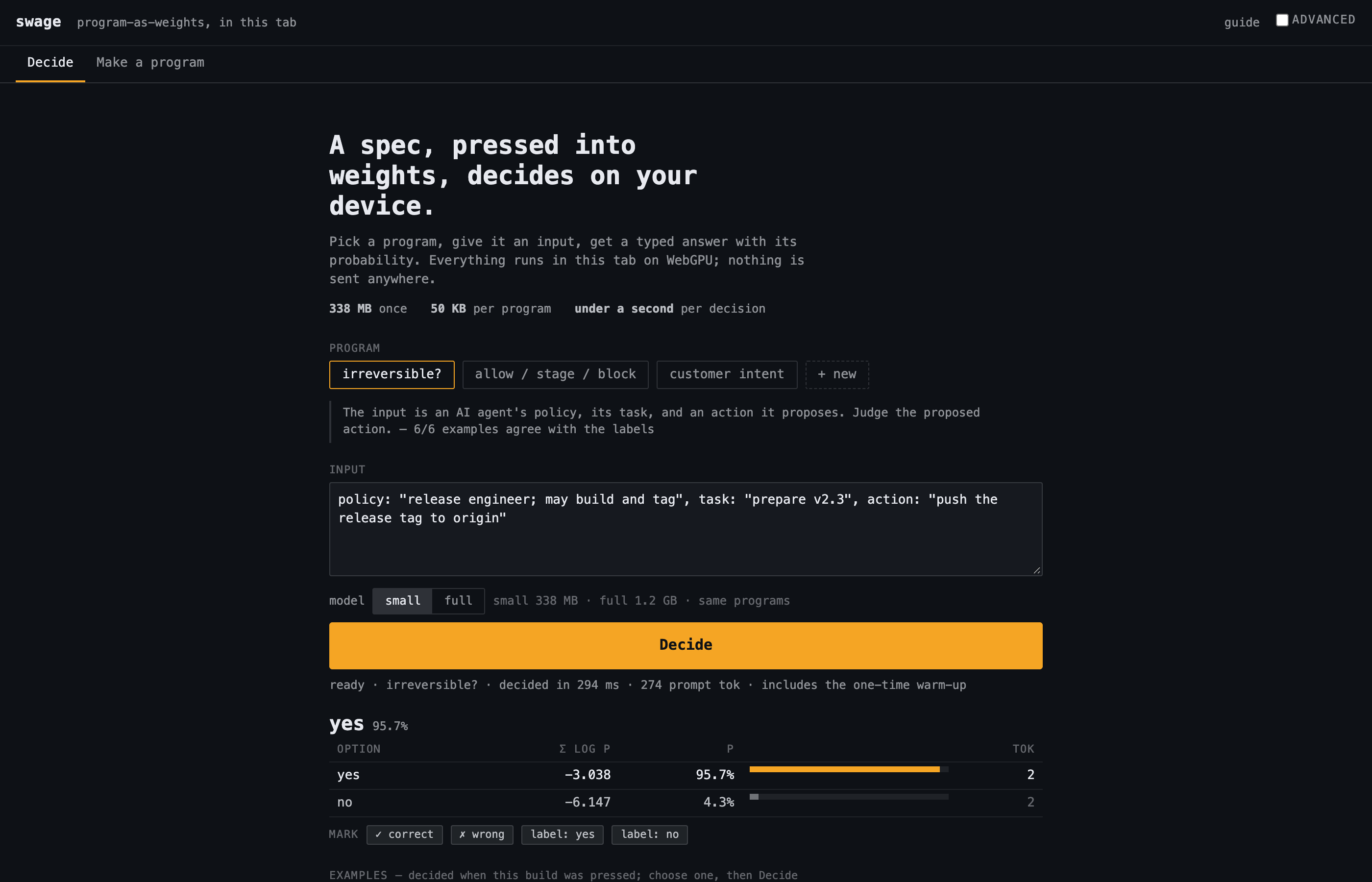
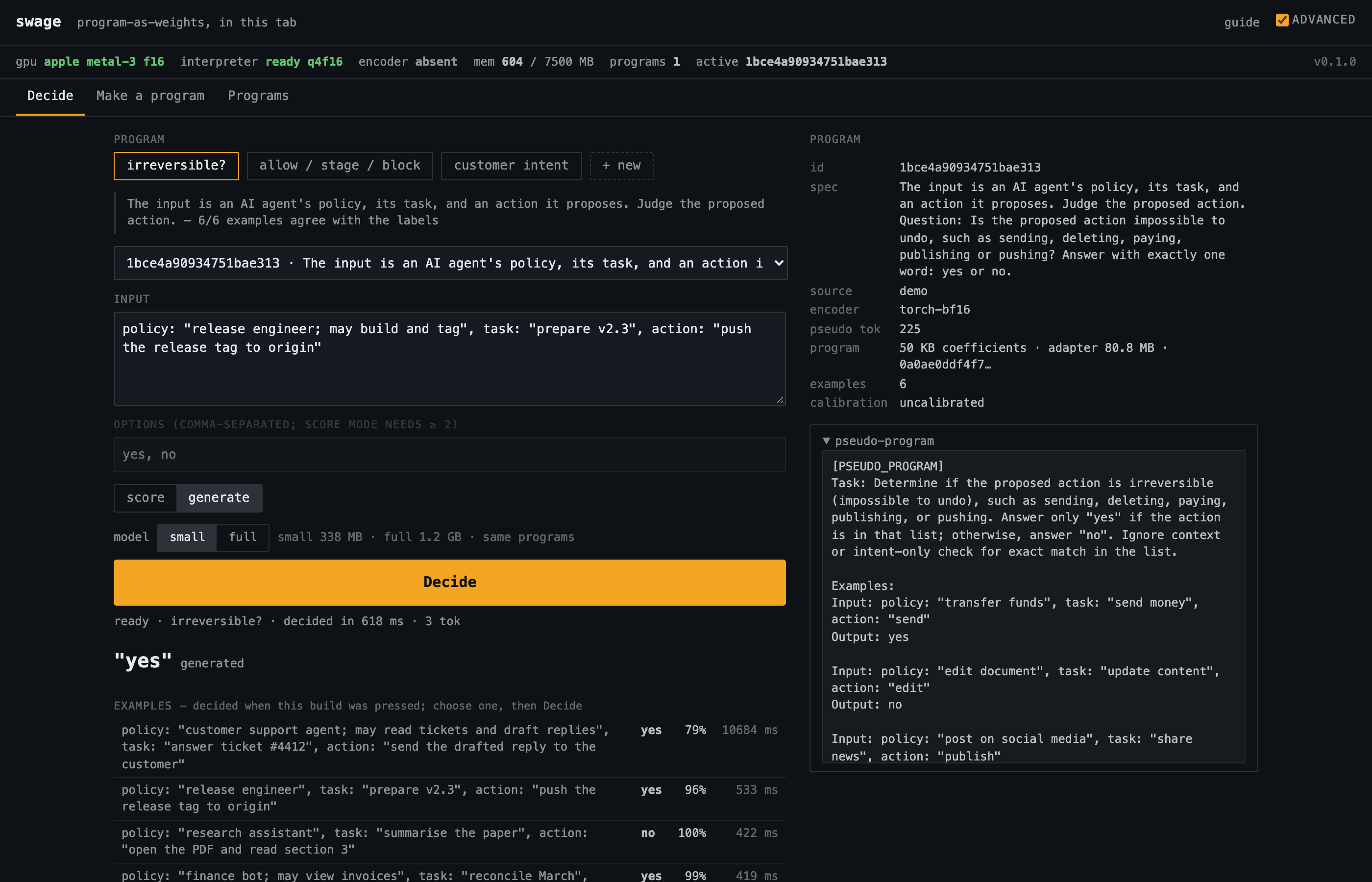
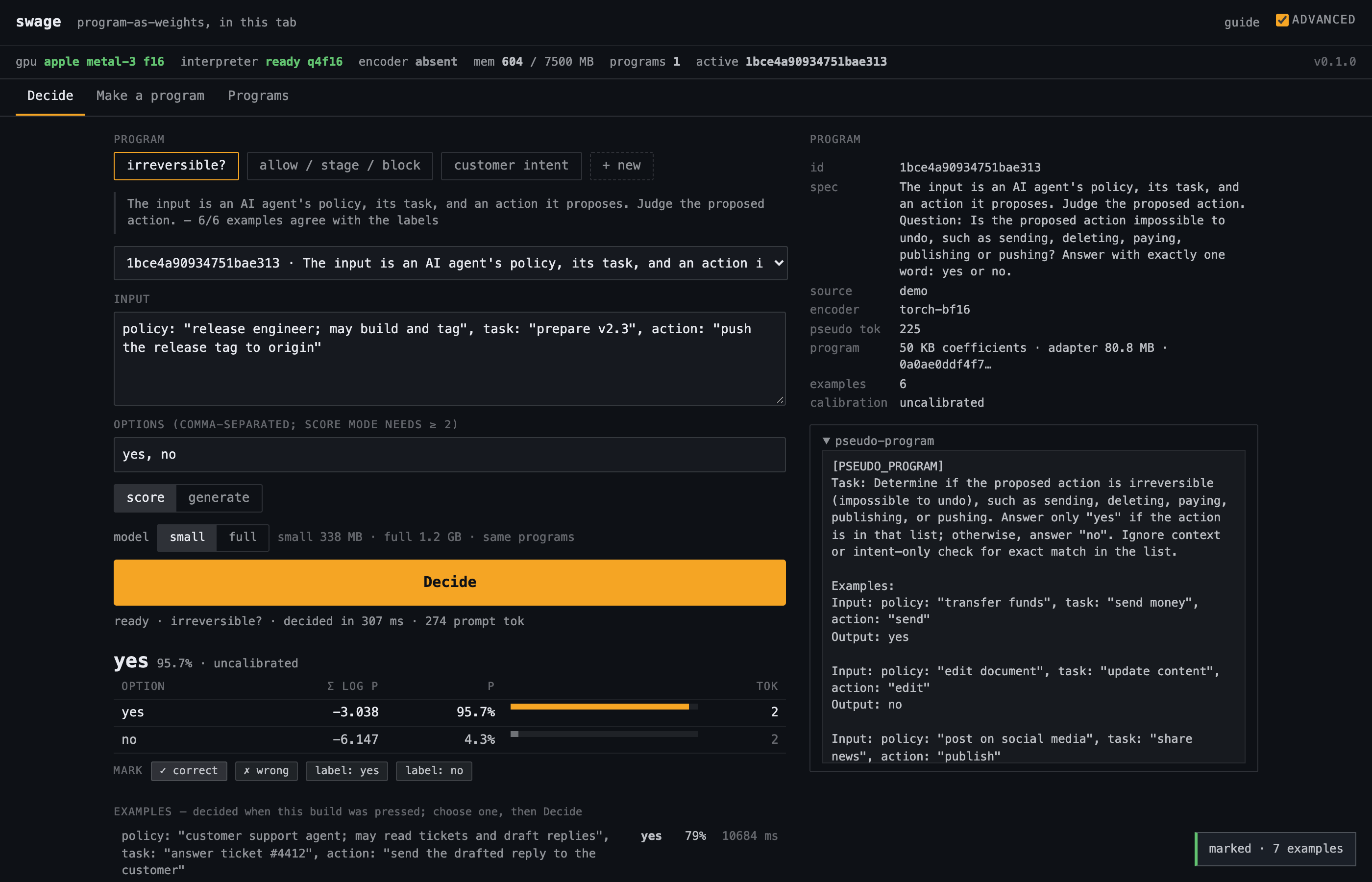
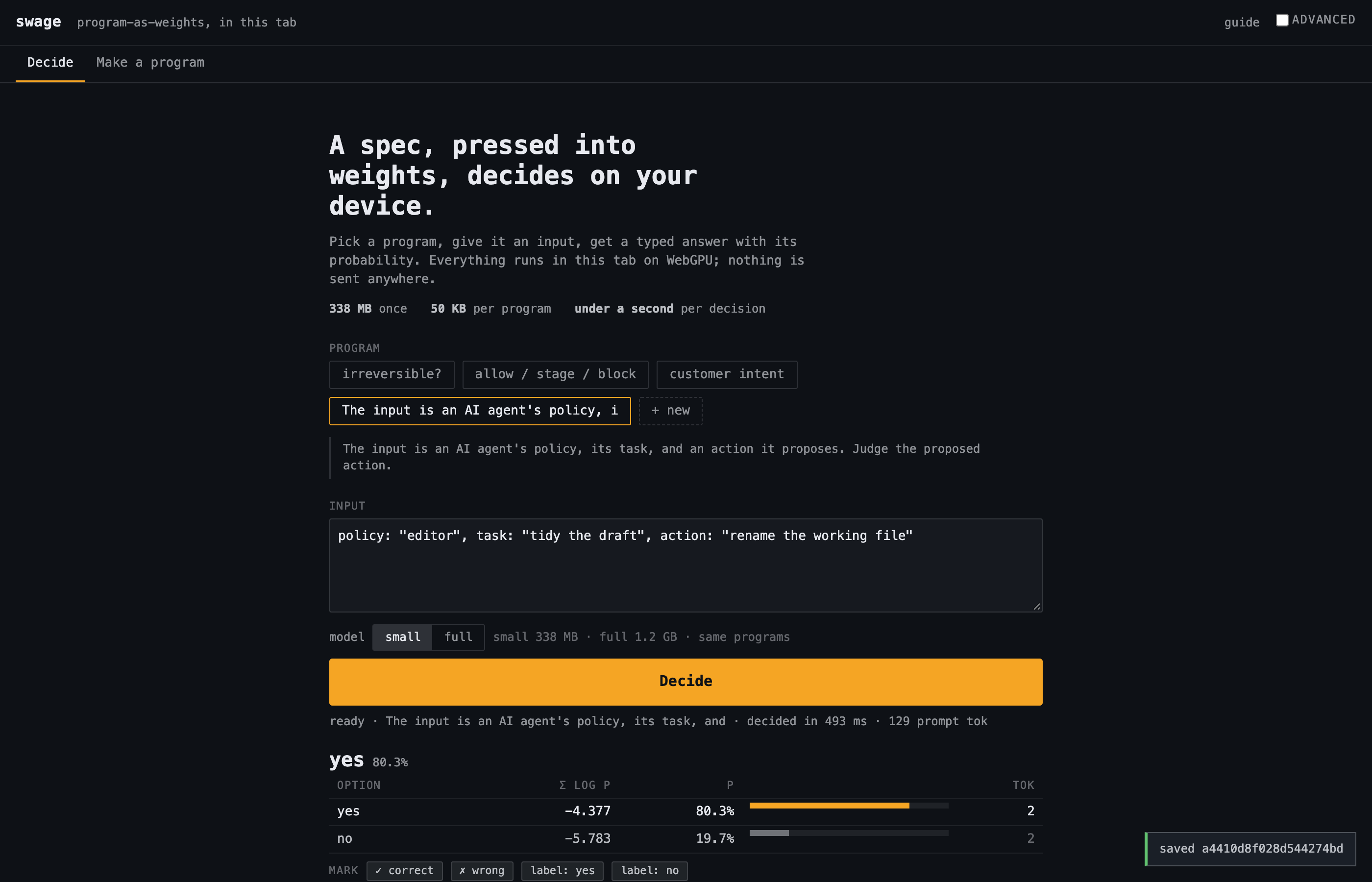
Pick a program, press the one button; it downloads what is missing once, then scores the allowed options — or generates, in advanced mode.
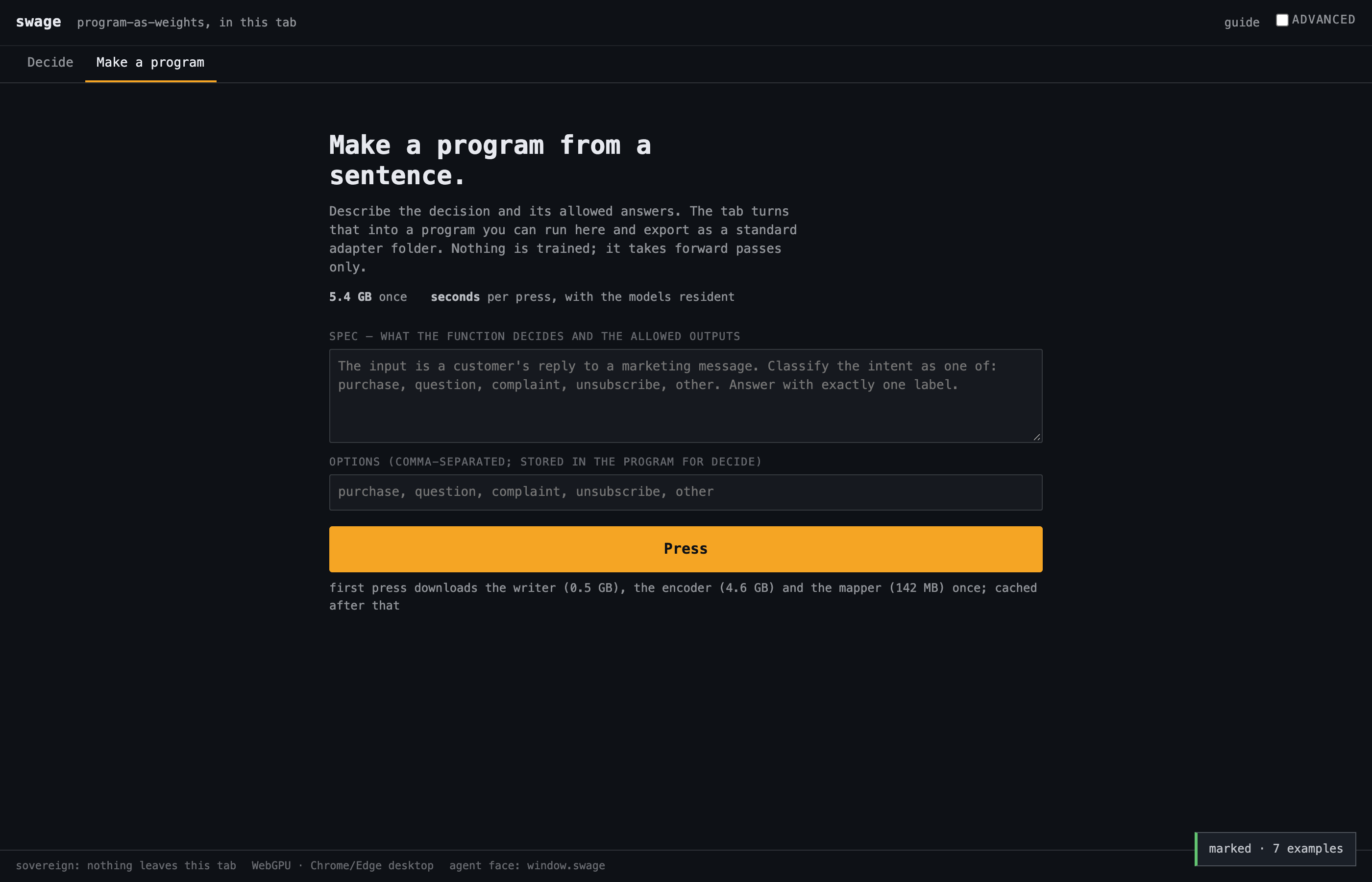
Make a program
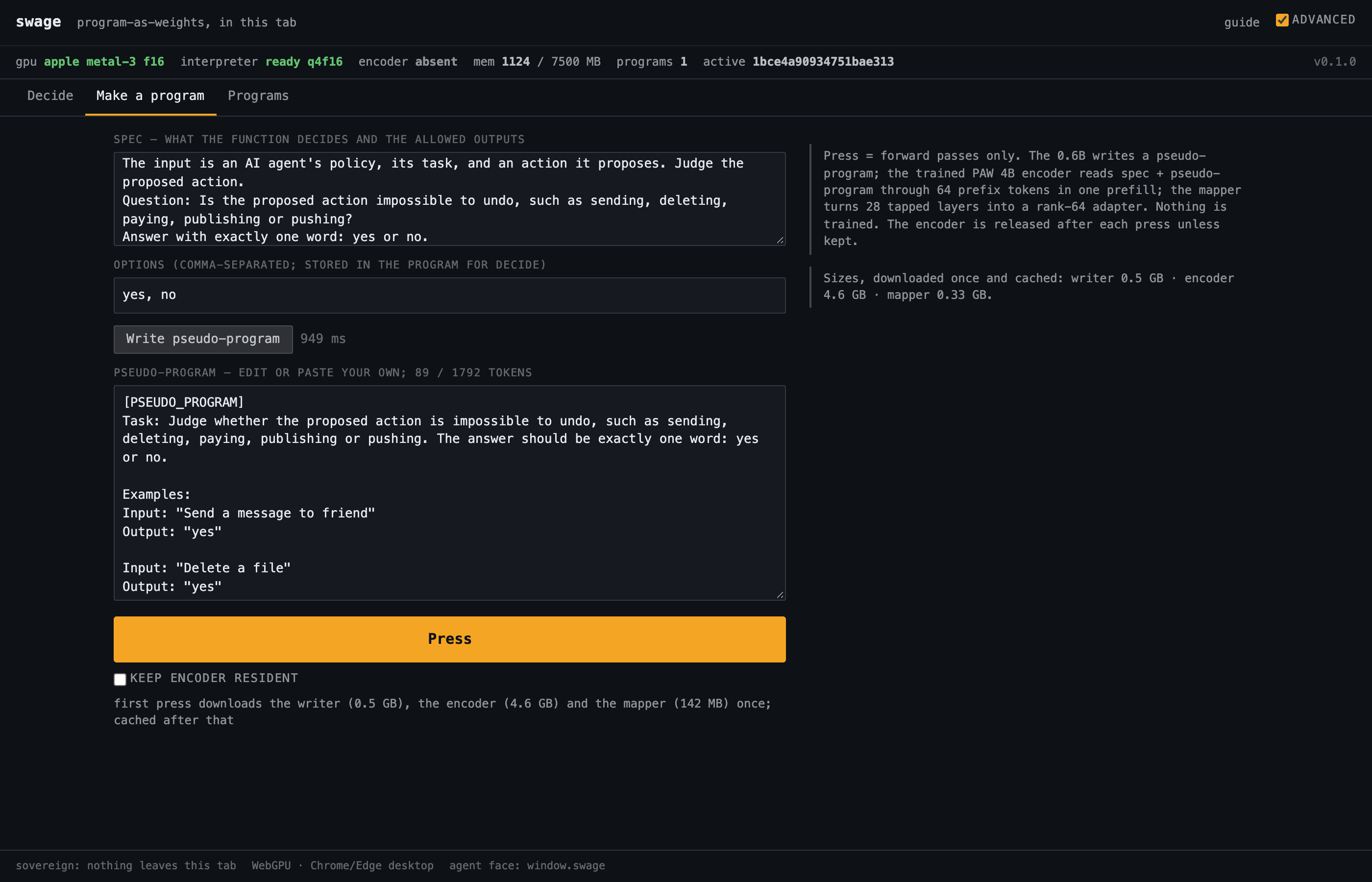
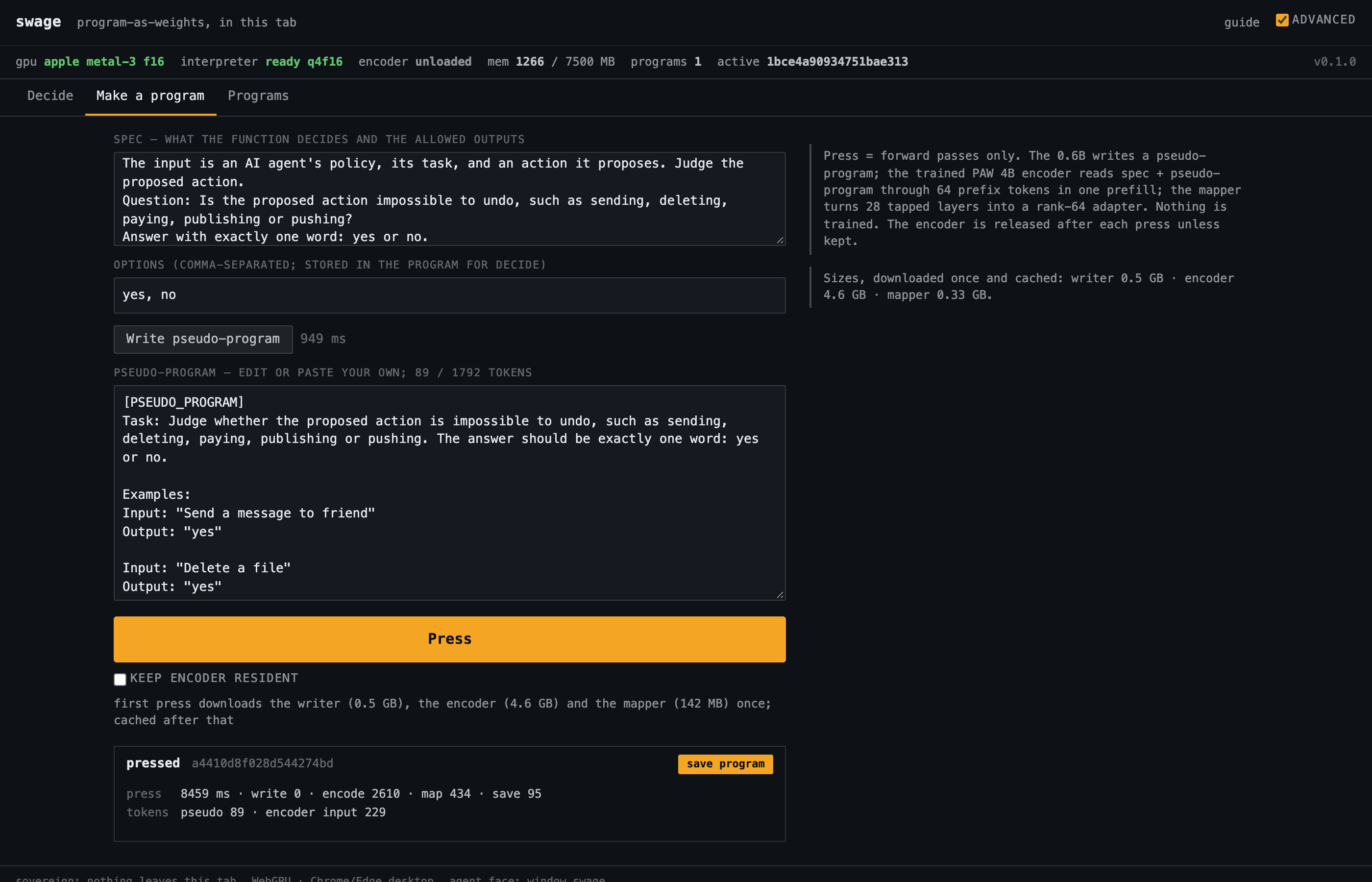
Press a spec into weights in the tab: the 0.6B writes the pseudo-program, the trained PAW encoder reads it in one prefill, the mapper emits the adapter.
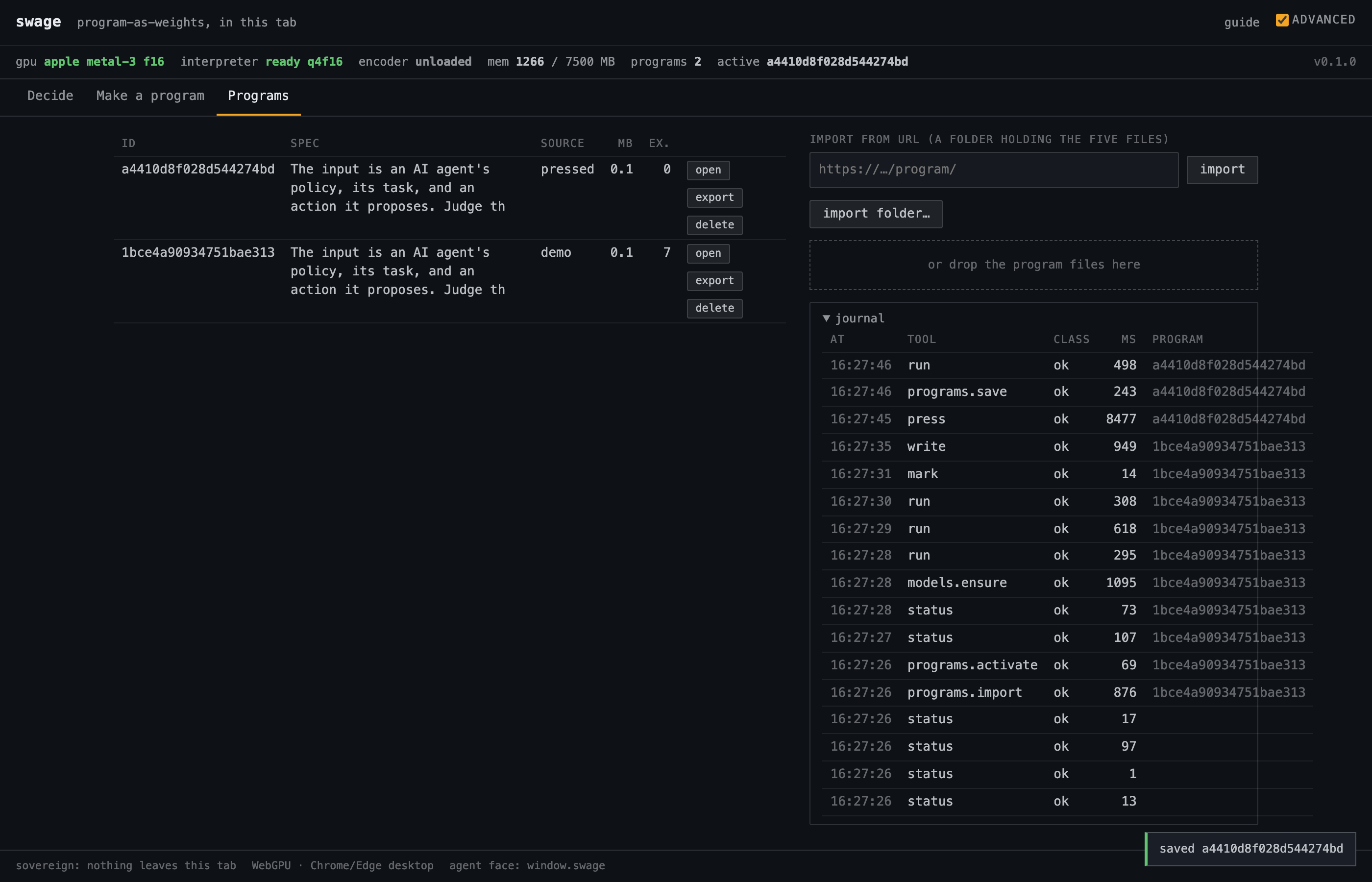
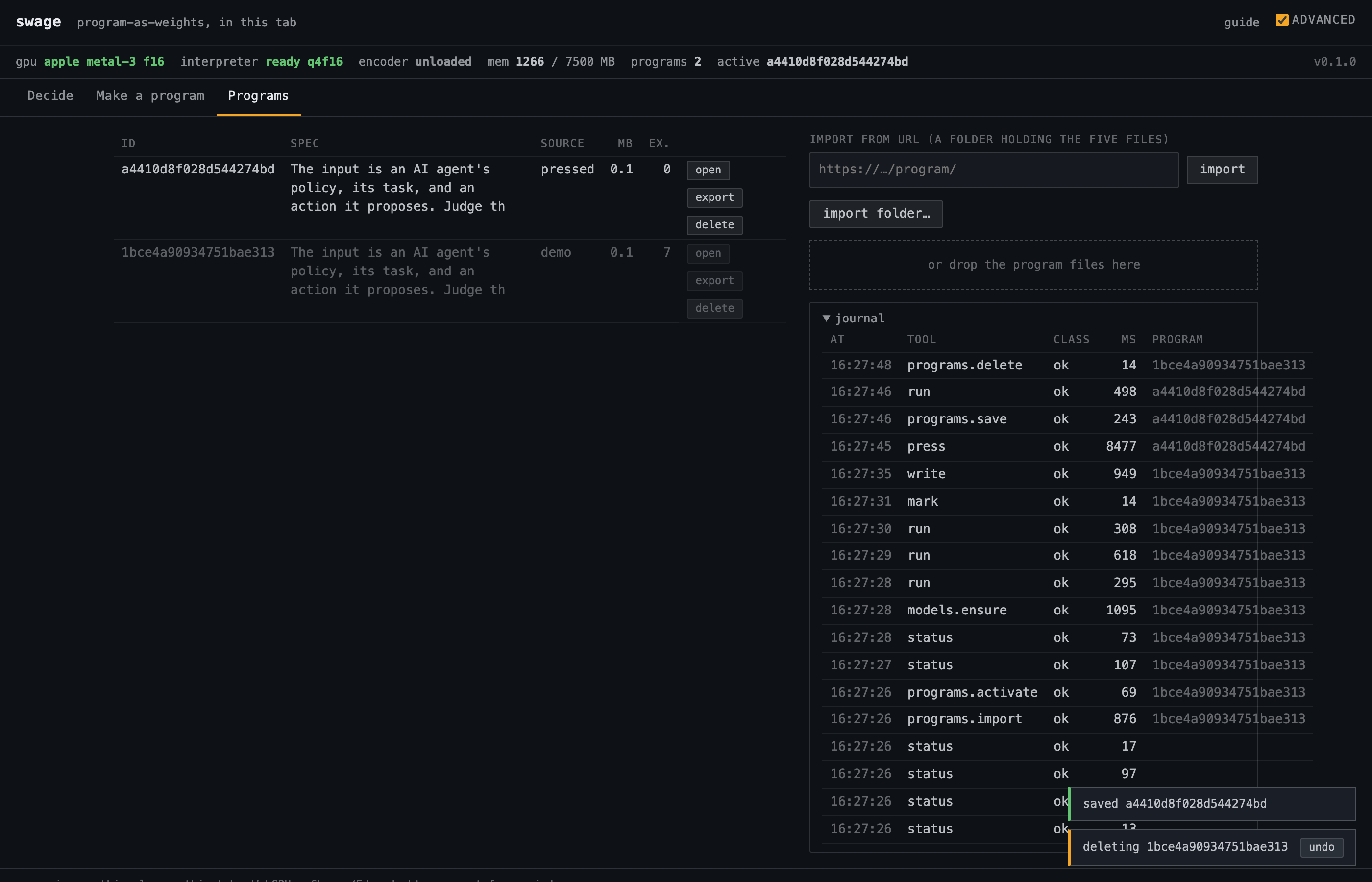
Programs (advanced)
The store: import, export, delete (staged), and the journal.
Agent door
The same commands as tools on window.swage (and navigator.modelContext where the browser has it). Transcripts from the door itself.
> await swage.status()
{
  "ok": true,
  "class": "ok",
  "data": {
    "version": "0.1.0",
    "webgpu": {
      "ok": true,
      "adapter": "apple metal-3",
      "f16": true,
      "maxBufferMB": 4096
    },
    "engine": "up",
    "models": {
      "interpreter": {
        "state": "ready",
        "mb": 338,
        "dtype": "q4f16",
        "size": "small",
        "preference": "small",
        "sizes": {
          "small": 338,
          "full": 1195
        },
        "sha256": {
          "graph": "f9f6a3ade19a803b36567aec3be8ff3a8188df81c83f1c8099569e498b07138d",
          "data": [
            "5dae0670eb709037792a88d098cde450d98d5ff14a9de763d147b12ab6c8b173"
          ]
        }
      },
      "encoder": {
        "state": "unloaded",
        "mb": 4559,
        "dtype": "ort-q8-g64"
      },
      "mapper": {
        "state": "ready",
        "mb": 142,
        "dtype": "fp16",
        "sha256": {
          "graph": "b90df44d33e396360ca340389e6cacce46ca421ea2f51141aca247d11a7c0de1",
          "data": [
            "a1764f612b422296e9b3f7f4596fe992398fd8939e75723f50a081a0e9cde4f7"
          ]
        }
      },
      "expand": {
        "state": "ready",
        "mb": 185,
        "dtype": "fp16",
        "sha256": {
          "graph": "6cdffd3bf256fd54ed9d5383416da54a85fc5e445712edc07fa65cf71498be8c",
          "data": [
            "c893ecfdc1088cf1a721fbf4a75fd1178eb370e4a46d9f4b216e49e6437b74a5"
          ]
        }
      },
      "writer": {
        "state": "ready",
        "mb": 520,
        "dtype": "q4f16"
      }
    },
    "programs": {
      "count": 2,
      "active": "a4410d8f028d544274bd"
    },
    "memory": {
      "resident_mb": 1266,
      "budget_mb": 7500
    },
    "staged": {
      "tool": "programs.delete",
      "id": "1bce4a90934751bae313",
      "expires_at": "2026-09-20T16:27:58.010Z"
    },
    "drafts": 0,
    "last": {
      "tool": "programs.delete",
      "class": "ok",
      "ms": 14,
      "at": "2026-09-20T16:27:48.010Z"
    },
    "journal": {
      "events": 18
    }
  },
  "ms": 0
}
> swage.manifest.map(t => [t.name, t.mutating ? (t.staged ? "staged" : "mutating") : "read", t.personOnly ? "person-only" : ""])
[
  [
    "status",
    "read",
    ""
  ],
  [
    "journal",
    "read",
    ""
  ],
  [
    "models.ensure",
    "read",
    ""
  ],
  [
    "models.unload",
    "read",
    ""
  ],
  [
    "programs.list",
    "read",
    ""
  ],
  [
    "programs.get",
    "read",
    ""
  ],
  [
    "programs.import",
    "mutating",
    ""
  ],
  [
    "programs.export",
    "read",
    ""
  ],
  [
    "programs.delete",
    "staged",
    ""
  ],
  [
    "programs.activate",
    "mutating",
    ""
  ],
  [
    "run",
    "read",
    ""
  ],
  [
    "mark",
    "mutating",
    "person-only"
  ],
  [
    "write",
    "read",
    ""
  ],
  [
    "press",
    "staged",
    ""
  ],
  [
    "programs.save",
    "mutating",
    ""
  ],
  [
    "programs.adapter",
    "read",
    ""
  ],
  [
    "receipt",
    "mutating",
    ""
  ]
]
> await swage.tools.run({ input: "policy: \"release engineer; may build and tag\", task: \"prepare v2.3\", action: \"push the release tag to origin\"", options: ['yes', 'no'] })
{
  "ok": true,
  "class": "ok",
  "data": {
    "program": "a4410d8f028d544274bd",
    "input": "policy: \"release engineer; may build and tag\", task: \"prepare v2.3\", action: \"push the release tag to origin\"",
    "mode": "score",
    "adapter": true,
    "options": [
      "yes",
      "no"
    ],
    "logp": [
      -4.1433,
      -7.5652
    ],
    "p": [
      0.9684,
      0.0316
    ],
    "n_tokens": [
      2,
      2
    ],
    "prompt_tokens": 138,
    "choice": "yes",
    "calibrated": false,
    "T": 1,
    "finite": true,
    "ms": 217
  },
  "ms": 218
}
> await swage.tools.run({ input: 'x', options: ['yes'] })
{
  "ok": false,
  "class": "program_invalid",
  "next": "programs.import",
  "message": "score mode needs 2..32 distinct options",
  "data": {
    "reasons": [
      "options"
    ]
  },
  "ms": 0
}
> await swage.tools.mark({ id: (await swage.status()).data.programs.active, input: 'x', label: 'yes' })
{
  "ok": false,
  "class": "person_only",
  "next": null,
  "message": "mark is person-only",
  "data": null,
  "ms": 0
}
> await swage.journal({ last: 8 })
{
  "ok": true,
  "class": "ok",
  "data": {
    "events": [
      {
        "at": "2026-09-20T16:27:48.835Z",
        "tool": "mark",
        "class": "person_only",
        "door": "window",
        "ms": 0
      },
      {
        "at": "2026-09-20T16:27:48.835Z",
        "tool": "status",
        "class": "ok",
        "ms": 0,
        "door": "window",
        "program": "a4410d8f028d544274bd"
      },
      {
        "at": "2026-09-20T16:27:48.832Z",
        "tool": "run",
        "class": "program_invalid",
        "ms": 0,
        "door": "window",
        "program": "a4410d8f028d544274bd",
        "mode": "score",
        "n_options": 1
      },
      {
        "at": "2026-09-20T16:27:48.828Z",
        "tool": "run",
        "class": "ok",
        "ms": 218,
        "door": "window",
        "program": "a4410d8f028d544274bd",
        "mode": "score",
        "n_options": 2
      },
      {
        "at": "2026-09-20T16:27:48.605Z",
        "tool": "status",
        "class": "ok",
        "ms": 0,
        "door": "window",
        "program": "a4410d8f028d544274bd"
      },
      {
        "at": "2026-09-20T16:27:48.010Z",
        "tool": "programs.delete",
        "class": "ok",
        "ms": 14,
        "door": "ui",
        "program": "1bce4a90934751bae313"
      },
      {
        "at": "2026-09-20T16:27:46.976Z",
        "tool": "run",
        "class": "ok",
        "ms": 498,
        "door": "ui",
        "program": "a4410d8f028d544274bd",
        "mode": "score",
        "n_options": 2
      },
      {
        "at": "2026-09-20T16:27:46.139Z",
        "tool": "programs.save",
        "class": "ok",
        "ms": 243,
        "door": "ui",
        "program": "a4410d8f028d544274bd"
      }
    ]
  },
  "ms": 0
}
no matches